Saturday, August 14, 2010

Tooth.....

Why do we have teeth?
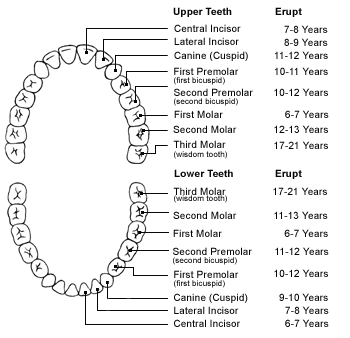
  • Teeth bite and chew food so that it is small enough to be swallowed.
  • Teeth help you to form words so that you can speak properly.               
  • You will have noticed that when young kids lose their front teeth, their voices sound quite different.


Tips for a healthy mouth, teeth and gums:

  • Clean your teeth well twice a day, after breakfast and last thing before you go to sleep at night. After a meal have a drink of water (this washes your teeth and mouth).
  • Use a small toothbrush with soft bristles. Hard and medium bristled toothbrushes can damage teeth and gums.
  • Use fluoride toothpaste. Spit it out when you have finished cleaning your teeth. Rinsing your mouth will wash out too much of the protective fluoride. 'Spit, don't rinse'.
  • Gently and thoroughly brush each side of every tooth and the gums. It should take about 3 minutes to do them all.
  • Avoid cleaning your teeth soon after drinking acid drinks such as orange juice. The acid in drinks softens the enamel, and cleaning can scratch the enamel while it is soft. Rinse your mouth with water, wait for about half an hour, then clean your teeth. 

  • Dental floss cleans between your teeth, get your dentist to show you how to use floss.
  • Wash your hands after going to the toilet and before using your toothbrush.
  • Don’t start smoking. It stains your teeth and can lead to disease in the mouth.

How do teeth decay?

  • Germs (bacteria) in our mouth grow on teeth every day. They form a sticky layer over the teeth called dental plaque.
  • The bacteria in plaque use sugars in the things we drink and eat, and make acids. The acid attacks the tooth’s outer layers (enamel and dentine) and eats them away. For more information about sugar and starches in food, have a look at the pamphlet 'Sugar' produced by the South Australian Dental Service.
  • If acid continues to attack, then a hole will appear in the tooth's outer layer. This is called tooth decay (or dental caries). Tooth decay may be painful or you may not even know it is there.
  • Saliva neutralises the acid in plaque. If the plaque is brushed off and saliva surrounds the tooth, the enamel surface can harden again. Fluoride helps the enamel to be repaired.

If the tooth continues to decay, a number of things could happen:


  • The tooth could break.
  • The nerve or pulp could get infected and the nerve could die.
  • You could have a toothache
  • You could get facial swelling. 

  • You might feel sick.
  • You might need a filling.
  • The tooth might need to be taken out


Keeping your toothbrush safe from germs


  • After brushing, rinse your toothbrush under running water.
  • Store your toothbrush in a clean dry place.
  • Do not share a toothbrush, as this can spread germs.
  • Replace your toothbrush often.

NEWS

China widens milk tests


The Ministry said it would test baby-formula maker Synutra International as well as other brands to compare the level of estrogen in dairy products, the People's Daily reported.


SHANGHAI - CHINA is expanding an investigation into reports of hormone-tainted milk powder by testing a range of infant milk powders and breast milk, state media said on Saturday, the latest food scare to hit the country.
The Ministry of Health launched the probe following complaints that tainted milk powder had caused baby girls to show signs of premature sexual development.
The Ministry said it would test baby-formula maker Synutra International as well as other brands to compare the level of estrogen in dairy products, the People's Daily reported on its website. 'In order to guarantee that the milk powder tests are safe and reliable, this time the Ministry of Health has chosen Beijing and Shanghai to test the products,' Liang Li, a medical expert, who is also a member of the investigation panel of the Ministry, was quoted as saying.
Shares of Synutra, a Chinese firm, plunged as much as 35 per cent earlier this week, but stabilised after the company denied the reports and said it was in the process of taking legal action to protect its brand.
Even if the allegations prove to be unfounded, the concerns about exposure to tainted milk products has underscored the persistence of food safety problems that have alarmed consumers, undermined China's global image and sparked criminal cases.
Two years ago, China was plagued with a melamine scandal when at least six children died and nearly 300,000 became ill from drinking powdered milk laced with melamine, an industrial compound added to fool inspectors by giving misleadingly high results in protein tests.

Thursday, August 12, 2010

Kidney


MAIN FUNCTIONS OF THE KIDNEYS................

  • Formation and secretion of urien
  • Production and secretion of erythropoietin, the hormone that controls formation of red blood cells.
  • Production and secretion of renin, an important enzyme in the control of blood pressure. 

Acute kidney failure

Definition

Acute (sudden) kidney failure is the sudden loss of the ability of the kidneys to remove waste and concentrate urine without losing electrolytes.

Causes, incidence, and risk factors

There are many possible causes of kidney damage. They include:
  • Acute tubular necrosis (ATN)

  • Autoimmune kidney disease, including:
    • Acute nephritic syndrome
    • Interstitial nephritis
  • Decreased blood flow due to very low blood pressure, which can result from:
    • Burns
    • Dehydration
    • Hemorrhage
    • Injury
    • Septic shock
    • Serious illness
    • Surgery


Symptoms

  • Bloody stools
  • Breath odor
  • Brusing easily


  • Changes in mental statusor mood
  • Decreased appetite
  • Decreased sensation, especially in the hands or feet
  • Fatigue
  • Flank pain (between the ribs and hips)

  • Hand tremor
  • High blood pressure
  • Metallic taste in mouth
  • Nausea or vomiting, may last for days


  • Nosebleeds
  • Persistent hiccups
  • Prolonged bleeding
  • Seizures
  • Slow, sluggish movements
  • Swelling - generalized (fluid retention)
  • Swelling of the ankle, feet, and leg swelling


  • Urination changes:
    • Decrease in amount of urine
    • Excessive urination at night
    • Urination stops completely

Wednesday, August 11, 2010

STRESS


What Is Stress?


Stress is a feeling that's created when we react to particular events. It's the body's way of rising to a challenge and preparing to meet a tough situation with focus, strength, stamina, and heightened alertness.

The events that provoke stress are called stressors, and they cover a whole range of situations — everything from outright physical danger to
making a class presentation or taking a semester's worth of your toughest subject.
The human body responds to stressors by activating the nervous system and specific hormones. The hypothalamus signals the adrenal glands to produce more of the hormones adrenaline and cortisol and release them into the bloodstream. These hormones speed up heart rate, breathing rate, blood pressure, and metabolism. Blood vessels open wider to let more blood flow to large muscle groups, putting our muscles on alert. Pupils dilate to improve vision. The liver releases some of its stored glucose to increase the body's energy. And sweat is produced to cool the body. All of these physical changes prepare a person to react quickly and effectively to handle the pressure of the moment.
This natural reaction is known as the stress response. Working properly, the body's stress response enhances a person's ability to perform well under pressure. But the stress response can also cause problems when it overreacts or fails to turn off and reset itself properly.


how to control stress?


Release negative emotions fast. Works well for stress, anxiety and anger!
Recover from fatigue fast
Relax and calm your mind and body in a matter of minutes.
Release limiting beliefs like "I'm not worthy of getting what I want"
Connect with who you really are and your true purpose.
Discover how to enter a state of “heart connection” where you feel peaceful AND connected to the best course of action for you right here and now.

Tuesday, August 10, 2010

BIRTHDAY GIRL......


HAPPY BIRTHDAY 20 YEARS TO SUHAILAH BINTI RAMLI...


10/08/2010
TEUSDAY


 Happy birthday to you....happy birthday to you....happy birthday to SUHAILAH BT RMLI...happy birthday to you...huuraayyy....we all pray hope that you well be more mature and become a good nurses in the future...yesterday nite,at 12.00 am..me,mastura,k.ain and yap had give her a present..we make her wake up from sleep..huhuhu...that the best thing we done to her..she in semi-conscious,wake up and look so blurr take our present and go to sleep back...so pretty to her...but..we hope she happy with that...


P/S: - suhailah thank to be our friend since 
             we know each others..
         -  for the 20 years you birthday, we hope 
             our friendship maintain forever.
          - love you shila..


Sunday, August 8, 2010

DENGUE


             What is dengue fever ?


Dengue Fever and Dengue Haemorrhagic Fever (a more severe form) are the most common mosquito-borne viral diseases in the world. Dengue Fever is an illness caused by infection with a virus transmitted by the Aedes mosquito. There are four types of this virus (serotypes 1 to 4) which can infect you.
Dengue Fever is spread though the bite of the Aedes Mosquito


   Lifecycle of Aedes Mosquito


Fast facts about the mosquito
  • Only the female aedes mosquito bites as it needs the protein in blood to develop its eggs.
  • The mosquito becomes infective approximately 7 days after it has bitten a person carrying the virus. This is the extrinsic incubation period, during which time the virus replicates in the mosquito and reaches the salivary glands.
  • Peak biting is at dawn and dusk.
  • The average lifespan of an Aedes mosquito in Nature is 2 weeks
  • The mosquito can lay eggs about 3 times in its lifetime, and about 100 eggs are produced each time.
  • The eggs can lie dormant in dry conditions for up to about 9 months, after which they can hatch if exposed to favourable conditions, i.e. water and food


1. Adjective : added to an adjective is a describing word, it is a word added to a noun to tell us something more about the noun
 Types : 1. descriptive adjectives
             2. predicative adjectives
             3. quantitative adjectives
             4. possessive adjectives
             5. interrogative adjectives


2. Adverb : an adverb is a word that added to the meaning of a verb, an adjective or another adverb. this means, it is a word that says something more about a verb, an adjective or another adverb.
Types :  1. adverb of time
             2. adverb of place
             3. adverb of manner
             4. adverb of degree
             5. emphasizing adverb
             6. interrogative adverb
             7. relative adverb
             8. sentence adverb

3. Noun : is a naming word, it is a name which identities something. In short, the work of noun in sentence is to name or identify a person, animal, a place or a thing.
Types : 1. common nouns
            2. proper nouns
            3. abstract nouns
            4. collective nouns
            5. compound nouns
 

4. Articles : are words such as a, an, the. These words are actually adjective, that is demonstrate adjectives. tough these are small words, they are very important.
Types : 1. the indefinite articles
            2. the definite articles

 
5. Verbs : is an active word it indicates doing, having or being the verb is used to say something about a person or object, it tell us what a person or an object does or is doing
Types : 1. main verbs  - regular verbs
                                  - irregular verbs
            2. auxiliary verbs
 

6. Prepositions : a preposition is a word which joins a noun or pronoun to another word and indicates some relation between the noun and pronoun and that other word.
Types : 1. simple prepositions
             2. compound/ derived prepositions
 

7. Conjunction : is a word used to join words or groups of words together or one sentence to another
 

8. Punctuations : is the use of certain marks or sign called stops, comma, semicolon